
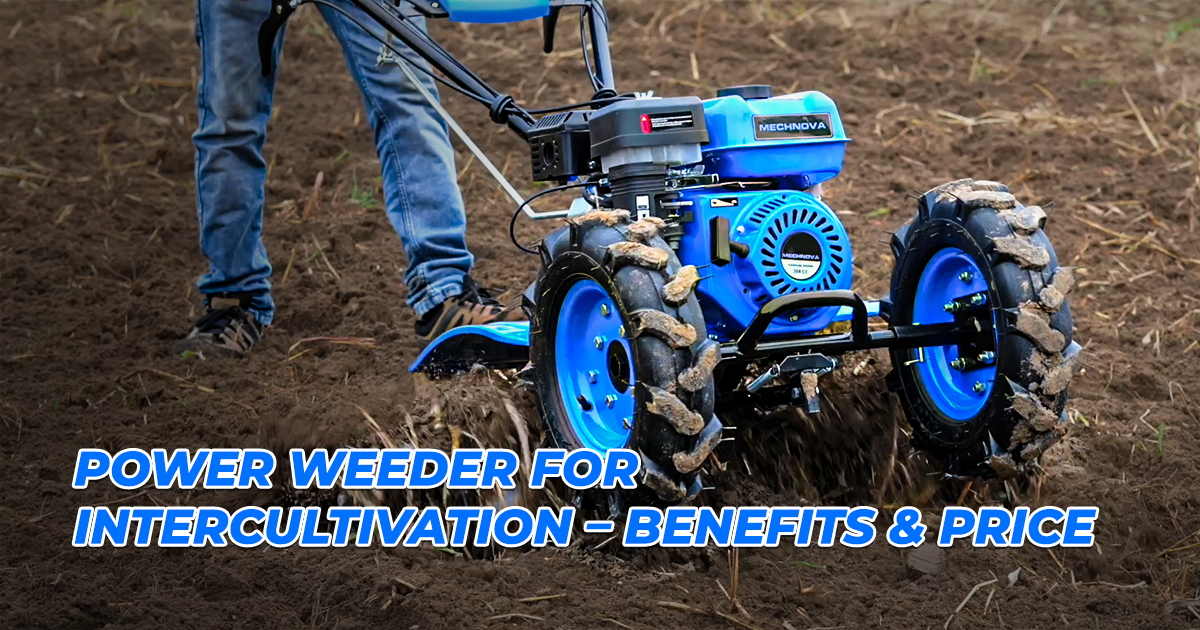
Nowadays, the farming sector has transformed greatly. Initially, all intercultivation jobs were labor dependent; consuming time and energy. The current trend of laborers’ costs are becoming higher & laborers not available during farming seasons, hence many farmers are adapting the machines to carry out field works easily & speedily.
Among these machines, a Power Weeder is one of them.
In current farming practice power weeders are now being largely adopted by the farmer for intercultivation, in vegetable, horticulture, row crops, and small to medium scale agriculture land. The purpose of the usage of this machine is to get rid of the weeds, enhance the physical state of soil, and maintain optimum growth of the crops without depending entirely on manual labor.
Farmers generally possess various questions like:
What is Intercultivation in Agriculture?
How does a Power Weeder perform the task of Intercultivation?
What are the Advantages of it?
How is the Cost of Power Weeder in India?
In this article, you will get the answers to all the questions in a simple and practically applicable language.
What is a Power Weeder?
A power weeder is a compact agricultural machine designed for weed removal and soil management between crop rows. It uses rotating blades to cut weeds and loosen soil simultaneously.
Most machines are powered by petrol or diesel engines and are available in different horsepower categories depending on farming needs.
Power weeders are commonly used in:
- Vegetable farming where regular weed control is necessary.
- Horticulture fields where larger tractors cannot move comfortably.
- Row crop farming where maintaining soil condition between rows is important.
Because of their compact design, these machines are especially useful in fields with limited operating space.
What is Intercultivation in Agriculture?
Intercultivation is all about farming tasks done between the crop rows after planting. Intercultivation plays an essential role in sustaining the proper soil structure and healthy crop development throughout the cultivation period.
Intercultivation consists of:
- Cleaning all the weeds that grow between the crops before their existence interfere with the crop’s nutrients
- Softening the upper soil layer to increase movement of air & water
- Removing of the hard crust on the soil, after rainfall or watering.
- Cleaning of crops between rows throughout the farming period.
Why Power Weeders Are Popular for Intercultivation
Intercultivation requires regular field maintenance throughout the crop cycle. Doing this manually repeatedly can become physically exhausting and expensive. Power weeders have become popular because they help farmers:
- Complete intercultivation works much faster than manual methods.
- Reduce dependency on seasonal labour during busy periods.
- Maintain more consistent soil condition across the field.
- Perform multiple operations like weed removal and soil loosening together.
This combination of speed and convenience makes them highly practical for modern farming.
These jobs were earlier being done by hands and manual instruments; hence it needs the involvement of substantial time & more labors. Now, with a bigger agricultural land & higher demand of labor, intercultivation can easily be done by machines for efficient farming.
Significant Advantages of using Power Weeder for inter-cultivation
1. Quick Weed Eradication
The primary benefits of a power weeder is speed of work.
Manually weed clearing can be very time consuming; particularly for small and medium farm holdings which often requires multiple laborers for multiple hours. Using a power weeder enables an individual to complete this task in a considerably shorter period.
With its rotating blades that efficiently cuts weeds in-between crop rows, it minimizes the effort greatly. It allows the farmers to finish the field maintenance during the critical agricultural seasons.
2. Good Aeration of Soil
Power weeders not only remove weeds; it has an added benefit of loosening the soil around the crop. With the rotating blades cutting into the soil, the upper layer becomes well-aerated.
This also helps to:
- Allow the movement of air readily among the roots.
- Enhance infiltration of water into the soil following irrigation or rain.
- Better absorption of nutrients for a healthy growth of crops.
Healthy roots are always a foundation for a good crop.
3. Reduces Dependence on Labor
Shortage of agricultural laborers is a major bottleneck in modern day farming. The lack of laborers during peak agricultural season and cost of labor for manual inter-cultivation tasks are high.
Power weeder helps overcome this problem, by:
- Enabling a single operator to carry out operations traditionally undertaken by several laborers.
- Ensuring work gets done without having to wait for available laborers.
- Making repetitive field work relatively effortless.
Over time this leads to one of the significant savings made by farmers in the form of reduction in labor cost.
4. Time Saving in Critical Periods
During the cultivation and irrigation period of cultivation, farmers have to perform multiple tasks within a limited time. Manual inter-cultivation is a time-consuming task and affects other farming operations. With a power weeder the inter-cultivation time is considerably minimized.
For example :
- An operation which normally takes an entire day by hand labor could be completed in hours.
- The farm operation could be carried out on larger fields without exhausting the user.
Petrol vs Diesel Power Weeder for Intercultivation
Various factors such as farm size, soil condition, and frequency of use affects the decision of choosing between a diesel and a petrol power weeder.
Petrol Power Weeder
Petrol models are generally lighter and easier to handle. They are commonly preferred for:
- Vegetable farming
- Small and medium landholdings
- Regular intercultivation work in softer soil conditions
They are also easier to maintain and simpler for everyday operation.
Diesel Power Weeder
Diesel models are more suitable for:
- Hard soil conditions
- Larger farms
- Longer working hours
Although the initial investment is higher, diesel machines are often preferred for heavy-duty agricultural work because of their stronger torque and better fuel efficiency over long durations.
Is buying a Power Weeder Worth It?
The answer to this question is subjective but for many farmers it is, Yes.
Although at the beginning the initial investment may seem significant but in long term run it becomes cost – effective over time because of :
- Reduced labour expenses.
- Faster completion of field work.
- Improved farming efficiency.
- Lower physical effort during regular intercultivation.
Farmers who frequently manage weed control and soil maintenance usually benefit the most from using these machines.
Important Things to Check Before Buying a Power Weeder
Before choosing a power weeder a farmer should clearly define and evaluate their requirement.
Important factors to be considered are :
- Farm size and crop spacing to ensure the machine fits comfortably between rows.
- Soil condition and whether heavy-duty operation is required.
- Frequency of machine usage during different farming seasons.
- Availability of spare parts and service support nearby.
Choosing the right machine according to actual farming needs is more important than simply buying the most powerful model available.
Conclusion
In today’s time power weeder has become one of the most essential tools in modern farming. With the help of it, field work can be completed more efficiently as it reduces labor dependency, improves soil condition, and completes work on time. It is an ideal machine for the small and medium farmers due to the reasonable cost, convenience in operation and efficiency.
As the cost of manual labor is rising day by day and the farming sector is going towards mechanization, it is estimated that the power weeders will find an increasing role in Indian agriculture. A power weeder selected according to the need of farm size will give return for a long period with the saving of time and labor cost.
