
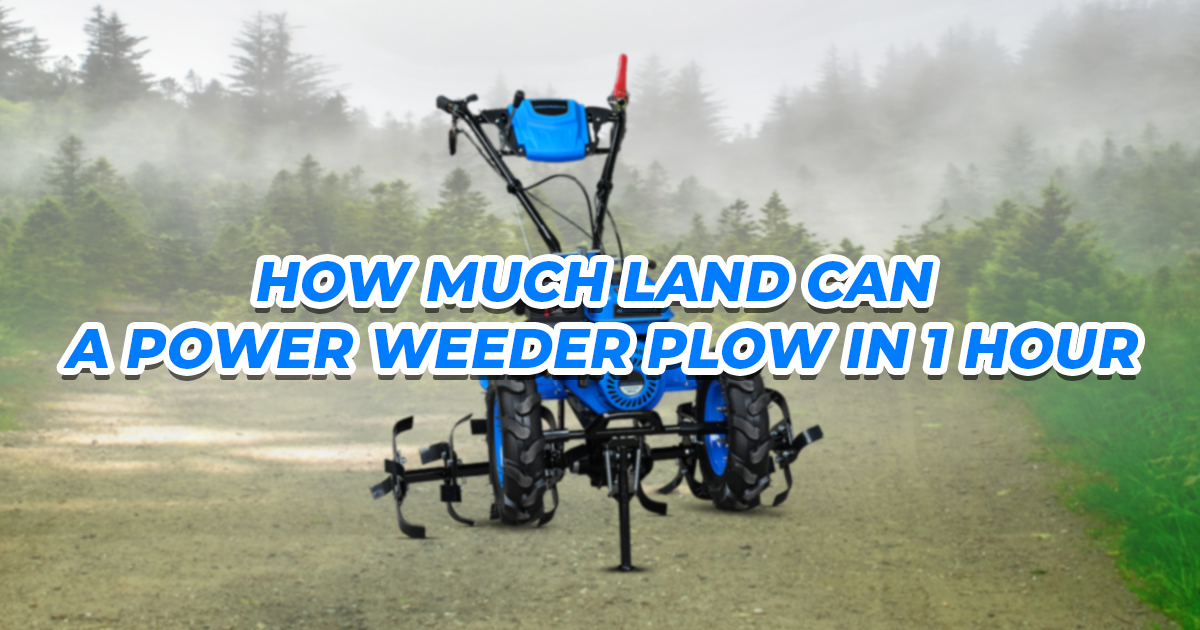
This is one of the most common queries asked by the farmer before buying a power weeder.
“How much land can this cover in one hour?”
This is a very important query as the answer determines the amount of fuel required, labor saved, and total productivity. In fact, the reason why a farmer buys a power weeder is to get done with his/her work sooner and save labor.
Now, here is the answer.
A small power weeder can plow about 0.25 – 0.5 acres in an hour
A regular 7 horsepower power weeder can plow 0.5 – 1 acres per hour
And heavy duty machines can clear more than that
However, actual results will be influenced by various aspects such as soil type, engine power, blade width, etc.
Let us see in detail how much land a power weeder can actually cover in an hour and the parameters influencing the operation.
Average Land Coverage of a Power Weeder
Providing a definite number is difficult as it depends on different models. Still, under normal circumstances here’s an approximate idea :
| Power Weeder Type | Average Coverage Per Hour |
| Mini Power Weeder | 0.25 – 0.5 acre |
| 5–7 HP Power Weeder | 0.5 – 1 acre |
| Heavy-Duty Diesel Models | 1 acre or slightly more |
What Affects the Coverage Area of a Power Weeder?
Many farmers assume that every power weeder works at the same speed, but that is not true. Several important factors affect how much land the machine can cover in one hour.
1. Engine Power
Machine engine power affects field efficiency considerably. High engine power machines such as those with 7 HP perform well due to greater torque capacity and enhanced tilling capabilities. They are able to move faster when dealing with both dry and wet soils.
Machines with lower HP are ideal in garden use, but higher HP machines are preferred on large farms for increased efficiency.
2. Working Width
Working width determines the area covered per pass by the machine.
Some examples are:
- A machine with a wider width covers more areas in less time.
- A machine with smaller working width covers less area per pass, hence taking more time.
This means that wider machines cover more areas than narrower machines, thus increasing efficiency on large open fields.
3. Soil Type
The nature of soil in the field affects the machine’s performance. On dry and loose soil, machines are able to operate faster since no extra efforts are required. Hard soil, on the other hand, requires more work, thus reducing the machine working speed. Muddy conditions in paddy fields slow the machine down as compared to dry cultivation land.
4. Field Size/Shape
Open fields allow the machine to operate faster without turning many times. Small and irregular shapes require the operator to turn the machine many times, thus covering a smaller area of land within the same period. Irregular shapes of the field, presence of stones, rocks, etc., affect the machine’s performance negatively.
5. Experience of Operator
Operator experience plays an important part in determining machine efficiency. New users work slower since they lack experience of how to handle and balance the machine. After several uses, farmers get experienced and handle their machines with ease.
Land Coverage According to the Power Weeder Type
Different working capacities are offered by different power weeder
1. Mini Power Weeders
Mini power weeders are small-sized machines, which are normally used for:
- Vegetable farming
- Gardening
- Nursery
- Small area cultivation
These machines can cover: 0.25 acre – 0.5 acre per hour
As they are light in weight and fuel efficient but not used for heavy duty farming.
2. 5HP to 7HP Power Weeders
These are the widely used machines in Indian agriculture and are used for :
- Paddy cultivation
- Vegetable farming
- Inter-Cultivation
- Soil preparations
These machines can cover: 0.5 acre – 1 acre per hour
They provide the best balance of power and efficiency of these machines and make them very popular among farmers.
3. Heavy Duty Power Weeders
Some heavy duty machines, equipped with high engine capacity and bigger tines can cover more than 1 acre per hour in some cases. These machines are normally used on large farms.
How a Power Weeder Saves Time Compared to Manual Weeding
Traditional weeding methods require several laborers and many hours of physical effort.
For example, manually weeding 1 acre of land may take:
- Multiple workers
- Several hours or even days
A power weeder can complete the same work much faster with fewer people involved.
This time-saving advantage is one of the biggest reasons why farmers are rapidly adopting agricultural machinery.
Fuel Efficiency and Working Capacity
Many farmers worry that higher coverage means higher fuel consumption. However, modern power weeders are designed to provide balanced fuel efficiency.
A standard 7 HP petrol power weeder generally consumes fuel efficiently while delivering strong performance.
Machines with:
- Better gear systems
- Proper engine tuning
- Good maintenance
often provide better productivity with optimized fuel usage.
This helps farmers reduce operational costs while increasing output.
Best Crops for Power Weeder Usage
Power weeders are highly versatile and can be used in multiple crops.
They are especially useful in:
Paddy Farming
In conditions of wet and semi – wet conditions weeders remove weeds and prepare soil effectively.
Vegetable Farming
Machines can easily work between crop rows in vegetables like tomato, chilli, onion, and brinjal.
Sugarcane Cultivation
Power weeders help loosen soil and remove unwanted growth between rows.
Cotton Farming
They improve soil aeration and reduce labor dependency during cultivation.
Orchard Farming
Compact weeders are useful for cleaning soil around trees and maintaining orchards.
Power Weeders – Ways to Enhance Their Efficiency
- There are some ways to enhance the efficiency of power weeders through certain methods.
- Sharp blades can help improve the efficiency of power weeders, thereby minimizing engine strain.
- Maintenance of power weeders is also vital in increasing their speed and improving efficiency.
- The use of proper gear when operating the machine will also result in better efficiency.
- The use of suitable gears in relation to soil conditions also makes power weeders more efficient.
Conclusion
Then what is the coverage area that a power weeder can till in an hour?
Under practical farming circumstances, an average power weeder can till 0.5 to 1 acre
But there are certain considerations affecting its output such as:
- Power rating of engine
- Soil type
- Tilling width
- Size of field
- Experience level of operator
For the farmers in India, power weeders are considered one of the most useful farming machinery. It saves time, reduces labor cost and makes their work easy and effective. Be you a small scale vegetable farmer or large-scale paddy fields farmer, the use of a good power weeder can revolutionize your work. With the modernization of agriculture, machines like power weeders will prove more useful to farmers in future as well.
