
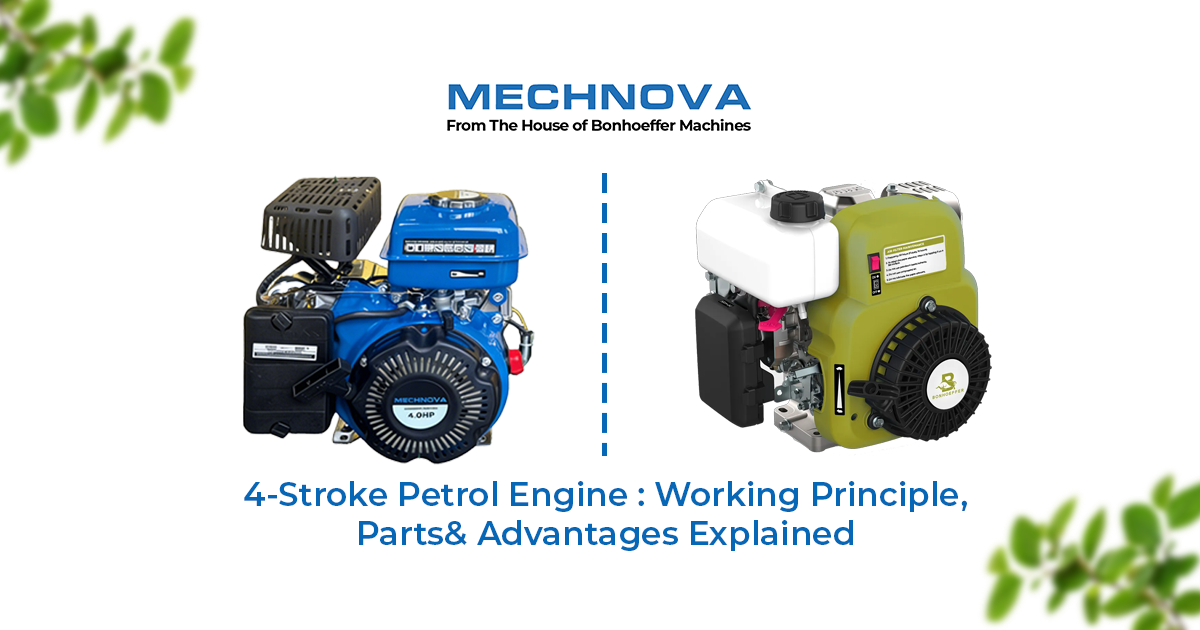
Have you ever wondered what gives life to the machines you use on your farm or in your garden every day? Whether you are clearing thick weeds or preparing the soil, the secret behind that hard work is often a 4-stroke petrol engine. These engines are the reliable hearts beating inside modern farm tools like brush cutters, grass cutting machines, power weeders, and power tillers. Even heavy-duty tools like a Chainsaw or a wood cutting machine rely on powerful engines to get the tough jobs done quickly. Brands like Bonhoeffer Machines use these engines because they provide steady, reliable power. Let us understand how these engines work in very simple words.
Key Parts of the Engine
Think of the engine as a strong metal box where small, safe fires happen to create power. Here are the main parts:
• Cylinder: This is a strong metal tube. All the action happens inside it.
• Piston: This is a solid metal block that fits perfectly inside the cylinder. It slides up and down.
• Crankshaft: This is a spinning rod connected to the bottom of the piston. When the piston goes up and down, it turns the crankshaft to spin the blades or wheels of your machines.
• Valves: These are like two small doors at the top of the cylinder. The intake door lets fresh air and fuel inside. The exhaust door lets the dirty smoke out.
• Spark Plug: This acts like a small electronic matchstick. It makes a tiny spark to light the fuel.
How It Works: The 4 Strokes Explained
The engine is called a “4-stroke” because the piston makes four separate moves to create power.
1. The Intake Stroke (Taking a Breath)
The piston pulls down inside the cylinder. The intake door opens, and the engine sucks in a fresh mixture of clean air and a little bit of petrol.
2. The Compression Stroke (Squeezing)
Now, both doors close tight. The piston pushes back up to the top. Because there is nowhere for the air and fuel to go, it gets squeezed very tightly together.
3. The Power Stroke (The Push)
When the mixture is squeezed the tightest, the spark plug fires a tiny spark. This lights the petrol and creates a small explosion. The force of this explosion pushes the piston down very hard. This hard push is what actually creates the power to run your farming equipment.
4. The Exhaust Stroke (Breathing Out)
After the explosion, the cylinder is full of leftover smoke. The exhaust door opens, and the piston goes up one last time to push all the dirty smoke out into the air.
Then, the cycle repeats itself thousands of times every minute!
Advantages of a 4-Stroke Petrol Engine
Why are petrol engines like these so common in farming equipment?
• Saves Money on Fuel: Because the engine carefully controls the petrol and air, it burns fuel completely. It does not waste a single drop, saving you money.
• No Mixing Oil: Unlike older 2-stroke engines, you do not have to guess how much engine oil to mix into the petrol tank. You just pour straight petrol into the tank, making it much easier to use.
• Quiet and Clean: These engines make much less noise and smoke. This makes long days working in the field much more comfortable.
• High Power: They deliver smooth and heavy power, perfectly suited for running large machines without stopping or stalling in thick soil.
Conclusion
By just repeating four simple steps : taking a breath, squeezing, pushing, and breathing out, a 4-stroke petrol engine does the heavy lifting for you. Understanding this simple process helps you take better care of the Bonhoeffer Machines tools you rely on. When your engine runs well, your daily farm work gets done faster and with much less physical effort.
 Mechnova Machines